Convenient
Five individual thaw-and-use tubes simplify repeat testing.
Determine the efficiency of cfDNA extraction from plasma or urine samples.
A convenient spike-and-recovery reference material designed to help quantify extraction recovery by comparing the amount added to a sample with the amount recovered after purification.
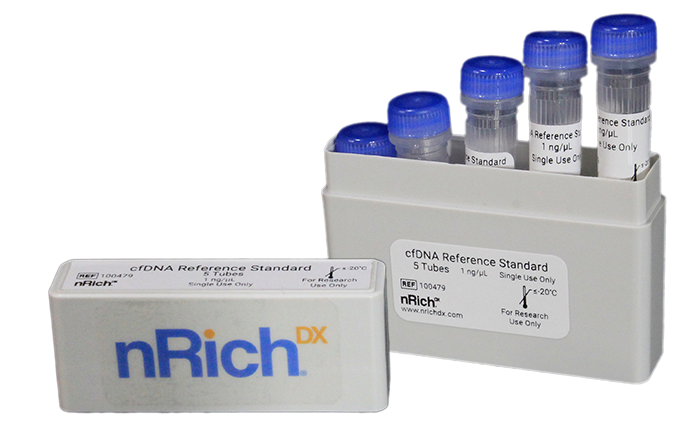
Spike a known amount of reference material into the sample, perform the extraction, then compare the recovered amount with the known input to calculate percent recovery.
Five individual thaw-and-use tubes simplify repeat testing.
Determine the efficiency of your cfDNA extraction method.
Supports spike-and-recovery cfDNA extraction experiments.
The reference standard provides a known input so extraction recovery can be calculated rather than assumed.
Begin with the plasma or urine sample and your selected extraction workflow.
Add a known amount of the cfDNA Reference Standard to the sample.
Process the spiked sample using the extraction method being evaluated.
Compare the spike-in amount with the recovered amount to determine percent recovery.
The reference standard contains mononucleosomal DNA derived from the NCI-H441 lung cancer cell line and includes KRAS G12V and TP53 Arg158Leu variants.
The material is deproteinized. Fragment sizes are nucleosome-defined, but histones are removed during purification.
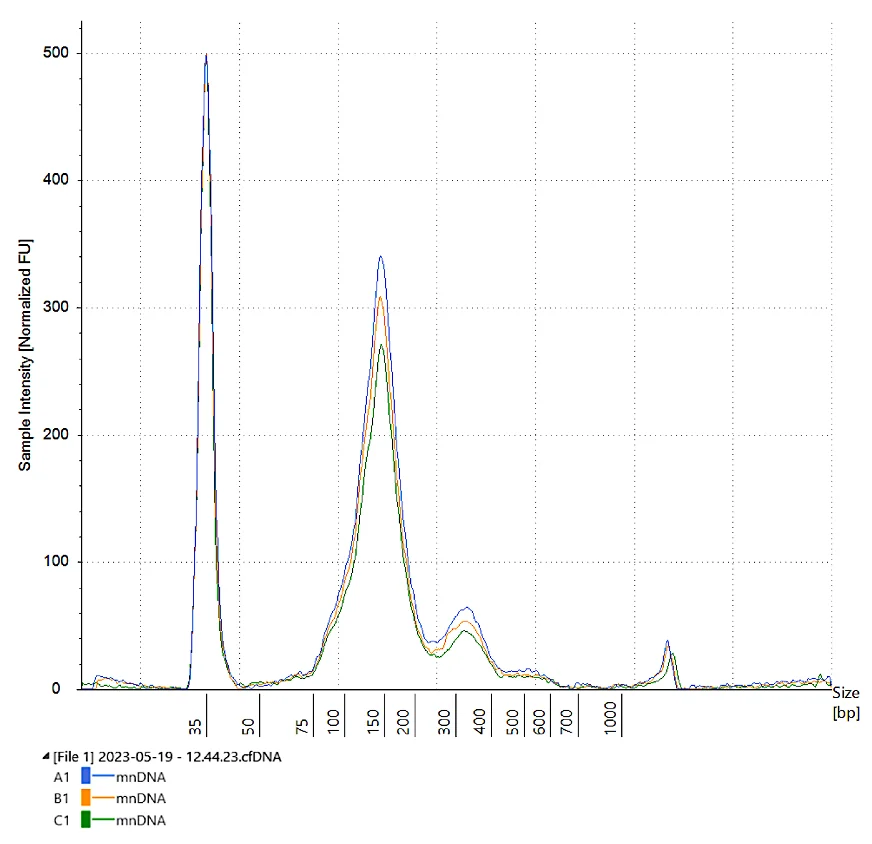
Representative fragment tracing of the cfDNA Reference Standard.
The current nRichDX reference-standard documentation includes gel and table data illustrating the expected material profile.
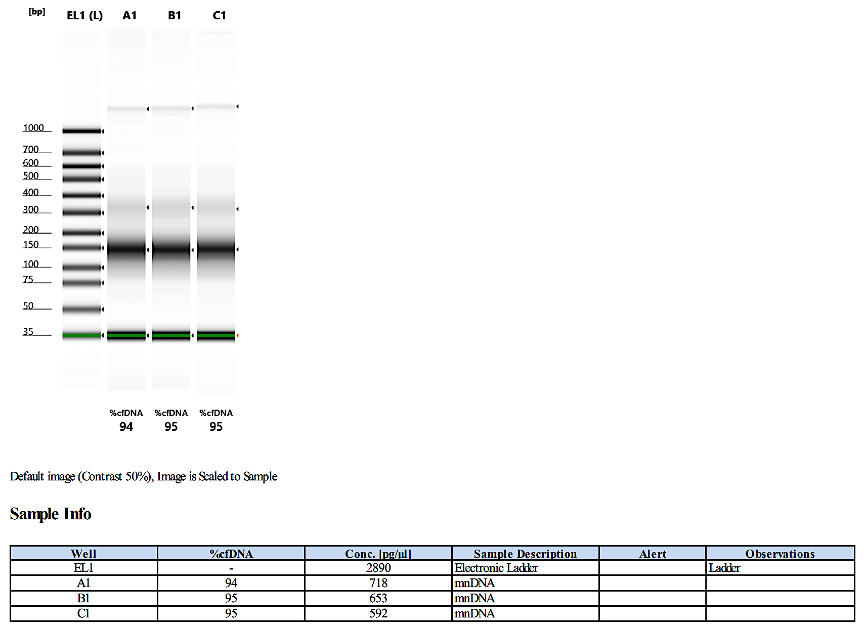
Expected results for the cfDNA Reference Standard.
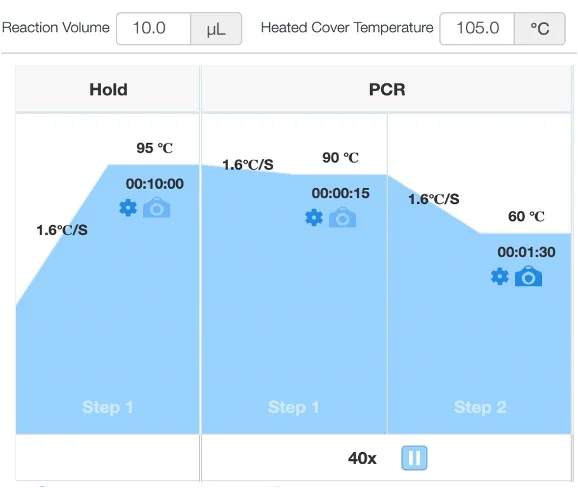
The current product page provides KRAS G12V probe and primer sequence information, preparation guidance, and cycling conditions for researchers using the standard.
| Type | Description | Quantity | Sequence |
|---|---|---|---|
| KRAS Probe | MGB Probe | 60 nmoles | /56-FAM/CTGTATCGTCAAGGCACT/3MGBEc/ |
| KRAS G12V | Forward Primer | 40–50 nmoles | AAACTTGTGGTAGTTGGAGCAGT |
| KRAS G12V | Reverse Primer | 40–50 nmoles | CATATTCGTCCACAAAATGATTCTG |
| Description | 500 µL | 1 mL | 2 mL | 5 mL |
|---|---|---|---|---|
| KRAS Probe (10 µM) | 250 µL | 500 µL | 1000 µL | 2500 µL |
| 10 mM Tris, 1 mM EDTA, pH 8.0 | 250 µL | 500 µL | 1000 µL | 2500 µL |
| Description | 500 µL | 1 mL | 2 mL |
|---|---|---|---|
| KRAS G12V Primer (6.25 µM) | 280 µL | 560 µL | 1120 µL |
| 10 mM Tris, 1 mM EDTA, pH 8.0 | 220 µL | 440 µL | 880 µL |
Current cycling conditions provided with the reference-standard assay information.
Access the current instructions for use or purchase the reference standard online.
Lampignano R, et al. Multicenter Evaluation of Circulating Cell-Free DNA Extraction and Downstream Analyses for the Development of Standardized (Pre)analytical Work Flows. Clinical Chemistry. 2020;66(1):149–160. doi: 10.1373/clinchem.2019.306837. PMID: 31628139.
The nRichDX cfDNA Reference Standard is for Research Use Only. Not for use in diagnostic procedures.
Spike. Extract. Measure. Quantify recovery.